
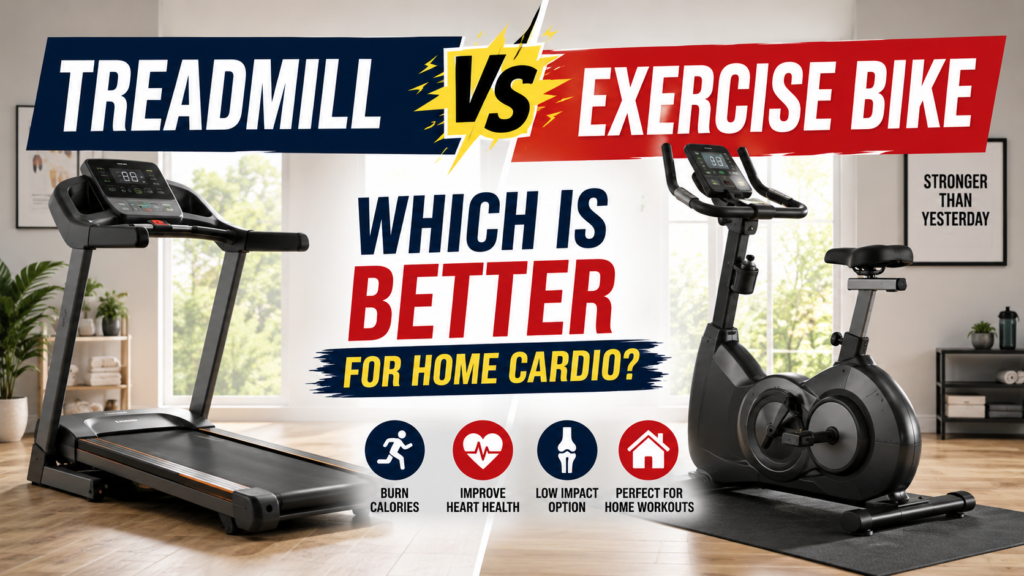
Picking your first (or next) piece of home cardio equipment usually comes down to two options: a treadmill or an exercise bike. Both burn calories, both fit in a home gym, and both have loyal fans — but they’re not interchangeable.
Here’s a full breakdown of how they compare on calorie burn, joint impact, space, price, and who each one is actually best suited for.
Quick Answer
- Choose a treadmill if you want higher calorie burn, functional fitness (walking/running carries over to daily life), and you don’t have joint issues.
- Choose an exercise bike if you have knee, hip, or back concerns, want a quieter/lower-impact workout, or have limited space.
- If weight loss is the only goal, either works — consistency matters more than the machine.
Treadmill vs Exercise Bike: Side-by-Side Comparison
| Category | Treadmill | Exercise Bike |
|---|---|---|
| Calorie burn (per hour, moderate effort) | Higher (~500–700 cal) | Slightly lower (~400–600 cal) |
| Joint impact | Higher (weight-bearing) | Low (non-weight-bearing) |
| Noise level | Moderate to loud | Quiet |
| Space required | Large footprint | Compact, some fold up |
| Price range | $400–$3,000+ | $200–$2,500+ |
| Beginner-friendly | Yes, but harder on joints | Yes, very forgiving |
| Best for | Running, walking, general fitness | Rehab, low-impact cardio, HIIT cycling |
| Functional carryover | High (walking/running is a daily movement) | Lower (cycling is more sport-specific) |
| Maintenance | Belt, motor upkeep | Simpler mechanically, less upkeep |
Calorie Burn: Which Torches More Calories?
Treadmills generally burn more calories per hour than stationary bikes at a matched perceived effort. That’s because running and incline walking are weight-bearing activities — you’re moving your entire body mass against gravity, which recruits more muscle and raises heart rate faster.
That said, exercise bikes can close the gap significantly with high-intensity interval training (HIIT) or spin-style workouts. A hard 30-minute cycling interval session can easily out-burn a slow, flat treadmill walk.
Bottom line: Treadmill wins for raw calorie burn at similar effort levels, but intensity matters more than machine choice.
Joint Impact: Which Is Easier on Your Body?
This is where the exercise bike clearly pulls ahead. Because you’re seated and the pedaling motion is smooth and circular, there’s almost no impact on your knees, hips, ankles, or lower back.
Treadmills — even with cushioned decks — are weight-bearing. Walking is relatively gentle, but running adds repeated impact forces that can aggravate existing joint issues or old injuries over time.
If you have knee pain, arthritis, are overweight and just starting out, or are recovering from a lower-body injury, a bike is the safer starting point.
Space and Noise
Treadmills take up a noticeably larger footprint — most need a dedicated area of roughly 3×6.5 feet even when folded, plus clearance behind and around them. The motor and belt also produce more consistent noise, especially at higher speeds.
Exercise bikes are more space-efficient. Many upright and folding models fit in a closet or corner, and they run much quieter — a real advantage in apartments or homes with shared walls.
Cost Comparison
Entry-level machines in both categories start around $200–$400, but the gap widens as you go up in quality:
- Budget treadmills: $300–$700 (basic motor, shorter belt, fewer programs)
- Mid-range treadmills: $800–$1,500 (better cushioning, incline, more durable motor)
- Premium/smart treadmills: $1,500–$3,000+ (large touchscreens, live classes, stronger motors)
- Budget bikes: $200–$400 (basic resistance, simple display)
- Mid-range bikes: $500–$1,000 (magnetic resistance, better seat, app connectivity)
- Premium/smart bikes: $1,200–$2,500+ (large touchscreens, live classes, high-end build)
Roughly comparable at each tier, though bikes tend to be slightly cheaper on average and require less maintenance over time (no belt to replace, simpler motor).
Which Is Better for Weight Loss?
Both work well for weight loss when used consistently — the “better” machine is the one you’ll actually use several times a week. That said:
- Treadmills tend to burn slightly more calories per session at similar perceived effort.
- Bikes make it easier to sustain longer sessions without joint fatigue, which can mean more total volume over a week.
For most people, adherence beats raw calorie burn per hour. If knee or back pain limits how long you can use a treadmill, a bike that lets you go longer and more often will likely produce better results.
Who Should Choose a Treadmill?
- You enjoy walking or running and want that skill/fitness to carry over to real life
- You don’t have joint issues that limit weight-bearing exercise
- You want the highest calorie burn per session
- You have the space for a larger machine
Who Should Choose an Exercise Bike?
- You have knee, hip, ankle, or back concerns
- You live in an apartment or want a quieter workout
- You’re new to exercise or returning after injury
- You want a compact machine that fits a small room
Can You Use Both?
If space and budget allow, combining both is ideal — many people use the bike for low-impact recovery days and the treadmill for higher-intensity running or walking sessions. Alternating also reduces overuse injury risk since you’re not repeating the same movement pattern every session.
Frequently Asked Questions
Is a treadmill or exercise bike better for beginners? Both are beginner-friendly, but an exercise bike is generally more forgiving on the joints and easier to start with if you’re deconditioned or carrying extra weight.
Which burns more belly fat, treadmill or bike? Neither machine targets fat loss in a specific area — spot reduction isn’t possible. Overall calorie burn and consistency determine total fat loss, and treadmills typically burn slightly more calories per hour at matched effort.
Is a stationary bike as good as running? For cardiovascular fitness, yes — cycling can produce similar heart and lung benefits. For bone density and functional leg strength used in daily walking, running has an edge since it’s weight-bearing.
Which is quieter, a treadmill or an exercise bike? Exercise bikes are almost always quieter, making them a better fit for apartments, early morning workouts, or homes with light sleepers.
Do treadmills or bikes take up more space? Treadmills generally need more floor space, even when folded. Bikes, especially upright and folding models, are more compact and apartment-friendly.
Final Verdict
If your priority is maximum calorie burn and you have healthy joints, a treadmill is the stronger overall cardio tool. If you want a low-impact, quiet, space-efficient machine — or you’re managing joint pain — an exercise bike is the smarter choice.
The best home cardio setup is the one that fits your body and your space well enough that you’ll actually use it consistently.