
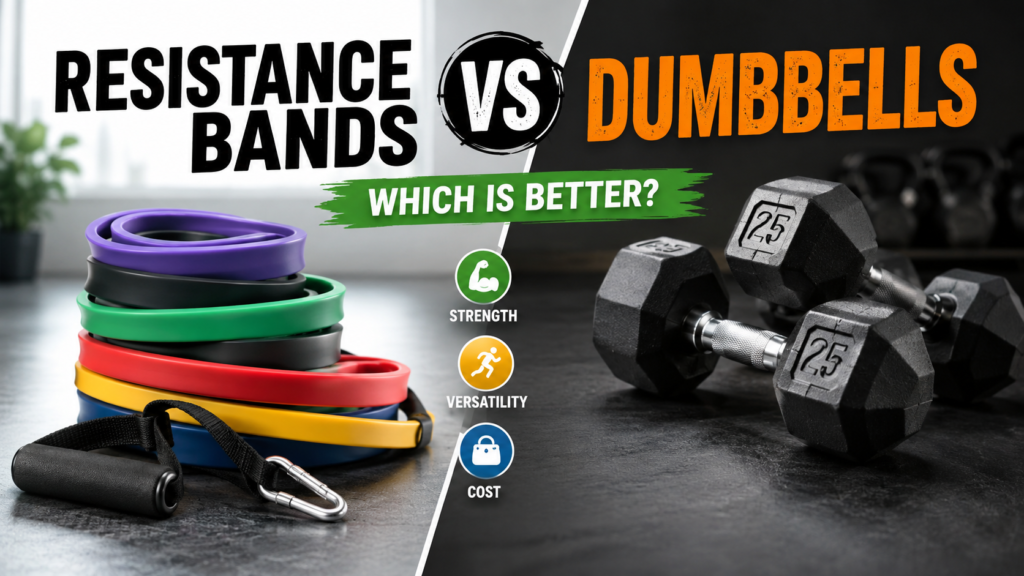
If you’re building a home gym or just trying to get stronger without spending a fortune, you’ve probably landed on the same question everyone does: resistance bands or dumbbells?
The honest answer is that neither one wins outright — they’re built for different jobs. Below, we’ll break down how they compare on muscle growth, strength gains, price, portability, safety, and long-term value, so you can figure out which one (or both) actually fits your goals.
Quick Answer
- Choose dumbbells if your main goal is building visible muscle and maximum strength, and you have space to store them.
- Choose resistance bands if you travel often, have limited space or budget, or you’re focused on rehab, mobility, or toning.
- Most people benefit from owning both — they’re more complementary than competitive.
What’s the Difference Between Resistance Bands and Dumbbells?
Dumbbells use gravity and fixed weight to create resistance. The load stays the same throughout the entire movement — a 20-pound dumbbell feels like 20 pounds whether your arm is fully extended or bent at 90 degrees.
Resistance bands use elastic tension, which means the resistance changes as you stretch the band. There’s very little tension at the start of a movement and significantly more at the end (this is called “accommodating resistance” or a strength curve).
That single difference is the root of almost every trade-off between the two.
Resistance Bands vs Dumbbells: Side-by-Side Comparison
| Category | Resistance Bands | Dumbbells |
|---|---|---|
| Muscle growth | Good, especially with heavier bands | Excellent, especially at higher loads |
| Strength gains | Moderate | High |
| Price | $15–$60 for a full set | $50–$400+ depending on weight range |
| Portability | Extremely portable, fits in a bag | Heavy, bulky, hard to travel with |
| Space required | Minimal | Moderate to large (especially adjustable sets or racks) |
| Joint stress | Low | Higher, especially with heavier loads |
| Progression | Harder to fine-tune | Easy to add small, precise increments |
| Injury/rehab use | Excellent | Limited |
| Beginner-friendly | Very | Very, with proper form coaching |
| Durability | Wears out over 1–3 years | Lasts decades |
Muscle Growth: Which Builds More Muscle?
Research comparing band-based and free-weight training has generally found similar muscle growth (hypertrophy) when the effort level is matched — meaning if you train close to failure with either tool, your muscles respond in a similar way.
Where dumbbells pull ahead is at higher strength levels. Once you get reasonably strong, most resistance band sets top out in the 50–150 lb range, which isn’t enough to keep challenging a compound lift like a squat or deadlift pattern for an advanced lifter. Dumbbells (especially adjustable sets) can scale much further.
Bottom line: For beginners and intermediates, bands can build real muscle. For advanced lifters chasing maximum size and strength, dumbbells (or barbells) become necessary eventually.
Strength Gains: Bands vs Dumbbells
Dumbbells generally win here for one simple reason: you always know exactly how much weight you’re lifting, and you can increase it in small, controlled increments (2.5–5 lb jumps). This precision is what drives consistent strength progression over months and years.
Bands are trickier to progress with. Resistance is usually described in ranges (“light,” “medium,” “heavy”) rather than exact pounds, and it changes throughout the rep. That said, bands do build real strength, particularly through a fuller range of motion at the top of a movement where dumbbells often lose tension.
Cost Comparison
A quality resistance band set (5–7 bands covering a wide resistance range, plus handles and a door anchor) typically costs $20–$60 and covers a beginner through advanced lifter for years.
A comparable dumbbell setup costs significantly more:
- A single pair of fixed dumbbells (e.g., 20 lb): $30–$60
- A full rack covering 5–50 lb: $300–$600+
- An adjustable dumbbell set (5–50 lb per hand): $200–$400
If budget is the deciding factor, resistance bands are the clear winner — you get a wider effective resistance range for a fraction of the price.
Space and Portability
This isn’t close. A set of resistance bands fits in a small drawer or a carry-on bag and weighs under two pounds total. Dumbbells, even adjustable ones, take up real floor space and can weigh 50+ pounds per pair.
If you travel for work, live in a small apartment, or want a home gym that disappears when you’re not using it, bands are the practical choice.
Safety and Joint Impact
Resistance bands are generally easier on the joints because tension builds gradually rather than hitting you with full load immediately. This makes them a common tool in physical therapy and rehab programs after injury or surgery.
Dumbbells, especially at heavier weights, put more direct stress on joints and require better form to use safely — a dropped dumbbell or poor technique under load carries more injury risk than a band snapping back.
When Resistance Bands Are the Better Choice
- You’re traveling or working out in a small space
- You’re recovering from an injury or doing physical therapy
- You’re a beginner building movement patterns before adding heavy load
- You want a cheap, complete home gym
- You want to add variable resistance to bodyweight exercises
When Dumbbells Are the Better Choice
- Your main goal is building visible muscle size
- You want precise, easy-to-track progressive overload
- You’re training for maximum strength
- You have the space and budget for a proper set
- You want a tool that lasts decades with zero wear
Can You Use Both Together?
Yes — and for most people, this is actually the best setup. A common approach:
- Use dumbbells for your main compound-style lifts (presses, rows, squats, lunges) where heavy, precise load matters most.
- Use resistance bands for accessory work, warm-ups, stretching under tension, and finishing burnout sets where the accommodating resistance is actually an advantage.
- Travel with bands only, and use dumbbells when you’re home.
This combo gives you the strength-building precision of dumbbells with the portability and joint-friendliness of bands.
Frequently Asked Questions
Can resistance bands replace dumbbells completely? For beginners and intermediate lifters, yes — bands can provide enough stimulus for real strength and muscle gains. Advanced lifters will eventually need heavier, more precise loading than most bands can offer.
Are resistance bands as effective as weights for building muscle? When training intensity (how close to failure you train) is matched, studies show similar muscle growth between bands and free weights. The gap widens mainly at higher strength levels.
Do resistance bands lose their strength over time? Yes. Bands typically need replacing every 1–3 years depending on use, since the elastic material stretches out and can develop small tears. Dumbbells don’t degrade this way.
What resistance band strength is equivalent to dumbbells? It varies by brand, but as a rough guide: light bands ≈ 10–20 lb, medium ≈ 20–35 lb, heavy ≈ 35–50 lb, and extra-heavy bands can exceed 50–70 lb of resistance at full stretch.
Which is better for beginners, bands or dumbbells? Both work well for beginners. Bands are often gentler for learning movement patterns and are more forgiving of imperfect form, while dumbbells teach you to manage precise, constant load from day one.
Final Verdict
Dumbbells and resistance bands solve different problems. If you had to pick just one and your priority is long-term strength and muscle growth, dumbbells are the safer long-term investment. If your priority is affordability, portability, or joint-friendly training, resistance bands deliver outstanding value.
The best home gyms usually don’t choose one — they use both.