
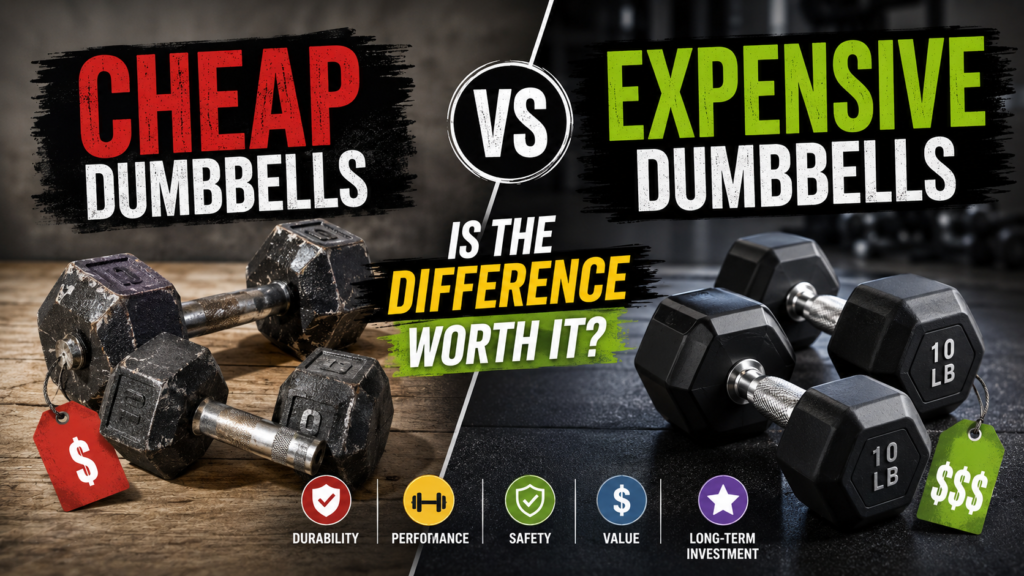
Dumbbells range anywhere from $1 per pound for basic vinyl-coated pairs to $3–4+ per pound for premium adjustable or rubber hex sets. That’s a massive price gap for what is, at its core, the same basic tool: a weight with a handle.
So does the extra money actually buy you something meaningful, or is it just branding? Here’s a full breakdown of what separates cheap dumbbells from expensive ones — and where it’s genuinely worth spending more.
Quick Answer
- Cheap dumbbells are worth it if you’re a beginner, on a tight budget, or only need a couple of fixed weights.
- Expensive dumbbells are worth it if you lift heavy, want a full weight range without cluttering your space, or plan to use them for years of serious training.
- The biggest real difference isn’t performance — it’s durability, space efficiency, and comfort under heavy, frequent use.
Cheap vs Expensive Dumbbells: Side-by-Side Comparison
| Category | Cheap Dumbbells ($10–$40/pair) | Expensive Dumbbells ($150–$500+) |
|---|---|---|
| Material | Vinyl-coated concrete, basic cast iron | Rubber hex, urethane, or adjustable steel/machined plates |
| Durability | Can crack, chip, or wear down | Built to last 10–20+ years |
| Grip comfort | Often slippery or textured plastic | Knurled or contoured metal grips |
| Weight accuracy | Can vary by 5–10% | Precisely calibrated |
| Space efficiency | Needs many pairs to cover a range | Adjustable sets replace 10–15 pairs |
| Noise/odor | Rubber/vinyl smell common, louder when set down | Minimal smell, often quieter |
| Warranty | Rarely offered | Often 1–10 year warranties |
| Resale value | Very low | Holds value well, especially adjustable sets |
| Best for | Light use, beginners, home occasional use | Frequent, heavy, long-term training |
What Actually Makes Expensive Dumbbells Cost More?
1. Material Quality
Cheap dumbbells are often made from vinyl-coated concrete or low-grade cast iron. These materials are functional but prone to cracking, chipping, or developing a rough, uneven coating over time — especially if dropped, which happens often during real training.
Premium dumbbells typically use solid cast iron with a rubber hex coating (great for protecting floors and reducing noise) or machined steel for adjustable sets. These materials hold up to years of regular dropping, stacking, and heavy use without degrading.
2. Grip Design
This matters more than people expect. Cheap dumbbells often have smooth, rounded, or hard plastic handles that get slippery with sweat. Higher-end dumbbells usually feature knurled (textured) metal grips that stay secure even during heavy, sweaty sets — which matters a lot for exercises like deadlift variations, rows, or overhead presses where grip failure is a real safety issue.
3. Weight Accuracy
Budget dumbbells, particularly vinyl or concrete-filled ones, can be surprisingly inaccurate — sometimes off by 5–10% from their labeled weight. For casual use this barely matters. For anyone tracking progressive overload seriously, that inconsistency can throw off your training log.
4. Space Efficiency (Adjustable Sets)
This is where the price gap becomes most justifiable. A single pair of adjustable dumbbells (e.g., 5–50 lb per hand) can replace 10+ pairs of fixed dumbbells, which would otherwise require a rack and significant floor space. If you’re working with a small apartment or spare room, this alone can justify the higher price tag.
5. Durability Over Time
Cheap dumbbells are usually fine for the first year or two of light-to-moderate use. But with frequent heavy training — dropping weights, stacking them, using them daily — vinyl coatings crack, concrete fill can shift or leak, and welded handles can loosen. Premium dumbbells are built to withstand years of harder use without falling apart.
Where Cheap Dumbbells Are Actually the Smarter Buy
- You’re a true beginner and don’t yet know if strength training will stick as a habit
- You only need 1–3 weight pairs (e.g., for light toning, physical therapy, or specific accessory exercises)
- Budget is the primary constraint and any dumbbells are better than none
- You train infrequently (1–2x per week, lighter loads)
For these use cases, spending $300+ on a premium set isn’t necessary — a basic $20–$40 pair will do the job just fine.
Where Expensive Dumbbells Are Worth the Investment
- You train 3+ times per week with real intensity
- You need a wide weight range and don’t have space for a full rack
- You’re lifting heavy enough that grip and durability actually matter
- You want the set to last a decade instead of needing replacement in 1–2 years
- You care about resale value if you ever want to sell or upgrade later
Do Expensive Dumbbells Actually Help You Build More Muscle?
No — and this is the most important point. A pound of resistance is a pound of resistance, whether it comes from a $10 dumbbell or a $200 one. Muscle doesn’t know the price tag. What expensive dumbbells improve is the experience and longevity of your training: better grip, more accurate loading, less risk of equipment failure, and more efficient use of space — not the muscle-building stimulus itself.
If your only goal is results, a cheap set used consistently will outperform an expensive set gathering dust.
Frequently Asked Questions
Are expensive dumbbells actually better quality? Generally yes — they use more durable materials, more accurate weights, and better grip design. But the performance benefit (muscle growth, strength gains) is the same as cheap dumbbells; the difference is in comfort, durability, and space savings.
Do cheap dumbbells wear out faster? Yes, especially vinyl-coated or concrete-filled ones. With frequent heavy use, coatings can crack or chip within 1–3 years, while premium cast iron or rubber hex dumbbells can last well over a decade.
Are adjustable dumbbells worth the extra cost? For most home gym owners with limited space, yes. A single adjustable pair can replace an entire rack of fixed weights, saving both money and floor space compared to buying 8–10 individual pairs.
Do I need expensive dumbbells as a beginner? No. Beginners are usually better off starting with an affordable set and upgrading later once they know how consistently they’ll train and what weight range they actually need.
What’s the biggest difference between cheap and expensive dumbbells? Durability and space efficiency, not effectiveness. Expensive dumbbells last longer, feel more comfortable under heavy use, and (for adjustable sets) save significant space — but they don’t build muscle any faster than a cheap pair.
Final Verdict
For casual or beginner use, cheap dumbbells are genuinely good value — they get the job done without wasted money. But for anyone training seriously, frequently, or with limited space, higher-quality (especially adjustable) dumbbells earn their price through durability, grip safety, weight accuracy, and long-term space savings.
The honest takeaway: spend based on how often and how heavy you’ll actually train — not on the assumption that a higher price automatically means better results.